THE NEW GEOPLUTONIC TECHNOLOGY
We produce energy solely from existing renewable resources, which are completely free of CO2. This new geothermal technology is actually as simple as it is ingenious.
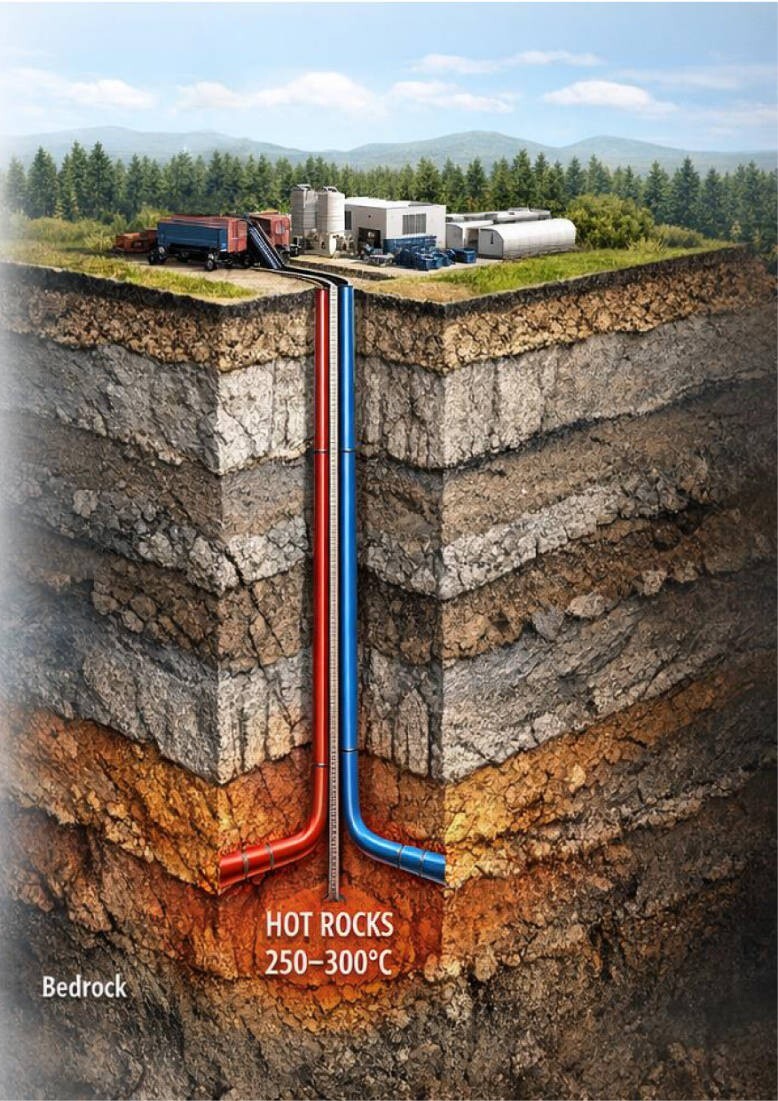
It is based on deep drilling up to ~12,000m. Subsequently, the closed double-walled
Pipe systems (pipe heat exchangers) are inserted into the secured, cemented boreholes, called "jet stingers", through which the heat-transfer fluid (enriched water) circulates.
We produce energy solely using existing renewable resources, which is completely free of CO².
Our Earth’s inner core is an inexhaustible energy source.
Let's start using this natural, existing energy source responsibly and sensibly, for the benefit of all people.
In the outer ring, the cold transfer fluid (enriched water) flows to a depth of up to 12 km and is heated by the hot soil/rock.
In the middle of the highly insulated pipe, core hot water is brought to the surface.
Above-ground thermal energy of the primary circuit is transferred through a heat exchanger to a secondary circuit that drives a conventional steam turbine (water vapor).
GEOPLUTONIC TECHNOLOGY
After the heat energy has been transferred to the heat exchanger, the cooled heat-transfer fluid (enriched water) from the primary circuit flows back down through the tube and is heated again.
A constantly repeating process occurs. There is no direct environmental contact between the heat transfer fluid and the ground. The efficiency of this process in terms of electricity production is about 34%.
The total efficiency, including thermal power, is about 90%.
A thermal output of at least approximately 36 MWh is achieved by each "jet stinger" (deep drilling). This corresponds to an electrical output of approximately 12 MW / stinger.
SURFACE TECHNOLOGY SIMPLE AS POSSIBLE
After the water vapour leaves the turbine, it still has a temperature of approximately 115°C.
Thus, independent from electricity production, heat energy of considerable magnitude is still
available and can be further utilised.
Depending on the local situation, it can be fed into a public district heating network or passed on to neighboring industrial or
commercial enterprises. If, considering all
possibilities, there is no use for the available thermal energy, the water is passed through another, downstream low‐ pressure turbine,
which increases the power efficiency from approximately 34% to approximately 50%.
The outlet temperature is then 40°C. The working medium (water) then passes through the closed secondary circuit.